
Loading...
Building a deck, addition, or retaining wall and need footings that will pass inspection and hold up through Simi Valley's clay soils and seismic risk? We dig, reinforce, and pour concrete footings with the city permit handled start to finish.
Concrete footings in Simi Valley are the underground base that holds up any structure built on your property - from a backyard deck or patio cover to a room addition or retaining wall - and most residential projects take one to three days of physical work once the permit is in hand, with two to four weeks total from first contact to finished footing when you include permitting and curing time.
Most homeowners reach out because they are adding something to their property and need to know the structural base is done right - or because they are seeing cracks, settling, or separation that points to a footing that is already moving or failing. Concrete footings in Simi Valley carry extra requirements because of the city's clay soils and seismic environment. A footing that works fine in a sandier, lower-risk part of California may not be adequate here. If you are building something that also needs a finished concrete surface above grade, pairing your footing work with foundation installation or a slab keeps the project moving on one permit and one schedule.
Every footing project we build in Simi Valley includes a city permit, a pre-pour inspection, and steel reinforcement sized for the load and the local soil. That is the standard - not an upgrade you pay extra for.
Cracks that angle outward from the corners of a doorframe or window opening often signal that part of your home's footing has shifted. In Simi Valley, the clay soil expands and contracts with the wet and dry seasons, and over time that movement can cause a footing to settle unevenly. This kind of cracking is not always a major problem, but it is worth having a contractor take a look before it gets worse.
When a footing shifts, the structure above it shifts too - and that movement often shows up first as doors or windows that used to work fine but now stick, drag, or won't latch. This is especially common in older Simi Valley homes after a wet winter followed by a dry summer, when the soil has gone through a full expansion and contraction cycle.
A gap opening up between your house and an attached patio cover, garage, or addition means the two structures are moving at different rates - often because one has a footing that is failing or was never adequate. In Simi Valley's seismically active environment, this kind of separation deserves prompt attention before the gap widens further.
Retaining walls hold back soil on sloped lots and depend on footings to stay upright. If a wall on your property is starting to lean forward or you can see horizontal cracks running across it, the footing may be failing. Given how many Simi Valley properties have hillside retaining walls, this is a common situation - and one where acting early is much cheaper than waiting until the wall fails.
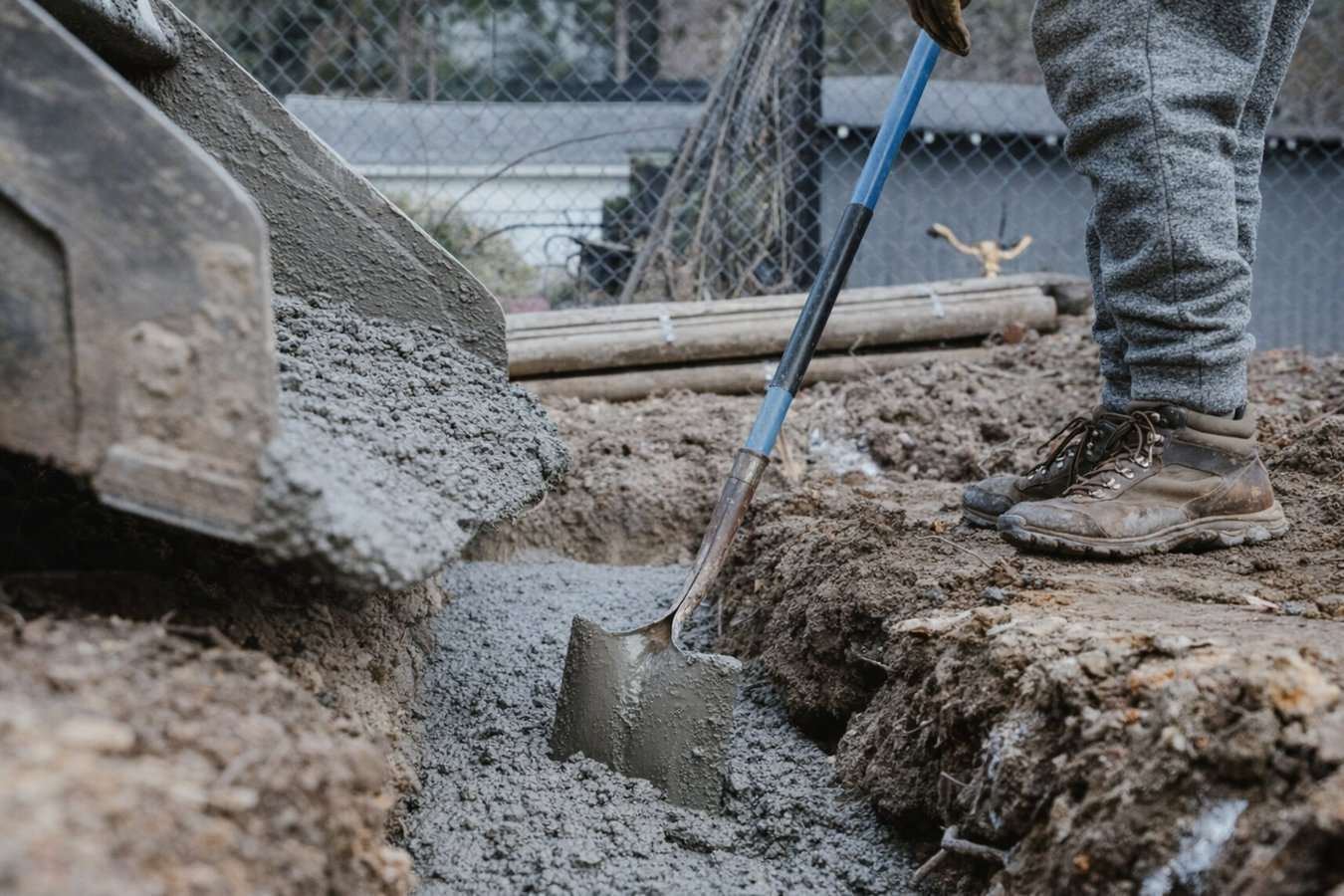
Every footing project starts with a site visit and a written estimate that reflects your actual soil and slope conditions - not a phone quote based on a best guess. We apply for the permit through Simi Valley's Building and Safety Division, prepare the required plans, and coordinate the city inspection so work can proceed on schedule. The footing trench is dug to the correct depth for your local soil and the load it will carry, steel reinforcing bars are placed to the approved plan, and the inspector signs off before any concrete is poured. On hillside lots - common in Simi Valley - we use stepped footing designs that reach stable soil on the downhill side without over-excavating on the uphill side.
For homeowners building a complete structure from the ground up, we frequently pair footing work with a foundation installation or a full foundation raising project. Coordinating these phases keeps the city permit, the inspection schedule, and the concrete delivery on a single timeline rather than treating them as separate jobs with separate delays.
Suits homeowners adding a new backyard deck, attached patio cover, or pergola that needs code-compliant footings before framing begins.
Suits homeowners building a room addition, ADU, or detached garage that requires a continuous perimeter footing designed for seismic loads.
Suits hillside property owners needing a properly sized footing to anchor a new or replacement retaining wall on a sloped lot.
Two local conditions shape every footing project in Simi Valley: the soil and the seismic risk. Much of the valley sits on clay-heavy soil that swells when it absorbs rain and contracts when it dries out in the summer heat. That ongoing push-and-pull puts stress on footings that were not designed with it in mind - and Simi Valley's hot summers can accelerate the problem by drawing moisture out of the soil faster than it can be replenished. A footing sized for sandier, more stable soil in another part of California may crack or shift here within a few seasons. Simi Valley also sits in a seismically active region. The 1994 Northridge earthquake was centered nearby and affected structures across the eastern Ventura County and western San Fernando Valley area. California's building rules require footings in this zone to include steel reinforcement designed to help structures flex during ground shaking rather than crack apart - and Simi Valley's Building and Safety Division enforces that standard through its permit and inspection process.
Hillside lots add a third layer of complexity. A significant portion of Simi Valley's neighborhoods - particularly in areas like Wood Ranch on the eastern side of the city - are built on or near sloped terrain. Sloped lots require stepped footings that go deeper on the downhill side to reach stable soil at a consistent level, which means more excavation and more concrete than a flat-lot project. Homeowners in neighboring Moorpark deal with many of the same clay soil and hillside conditions, and we bring the same site-specific approach to every project we take there.
Reach out by phone or contact form and we will respond within one business day. We ask about what you are building, where on your property it will go, and whether you have already spoken with the city. Most projects need a site visit before we can give you a reliable written quote.
We visit your property to look at the location, assess the soil, check for slope, and measure the scope. Your written estimate covers excavation, steel, concrete, and permit fees separately - so you can see exactly what you are paying for, not a single number that hides the details.
We apply for your permit through Simi Valley's Building and Safety Division and schedule the pre-pour inspection. Once approved, we dig the trench, place steel reinforcing bars to the approved plan, and wait for the city inspector to sign off before any concrete is poured.
We pour the concrete - usually in a few hours - and protect the surface from Simi Valley's dry heat during the curing period. Once the footing reaches working strength, we backfill and clean up the site. You get the inspection record and any documentation you need for the next phase of your build.
Free on-site estimate. Permit handled by us. Steel-reinforced and inspection-ready.
(805) 285-4986Footings that fail inspection because the depth, dimensions, or steel placement is off create costly delays and rework. We build every footing to the approved plan from the start, so the inspector's visit is a confirmation, not a problem. That means your project keeps moving rather than stalling while corrections are made.
A significant share of Simi Valley's neighborhoods sit on or near sloped terrain - and hillside footing work is more complex than flat-lot work. We have done stepped footing projects across the valley's hillside neighborhoods, and we visit every sloped property in person before quoting. A phone estimate on a hillside lot is almost always wrong.
Every footing we pour in Simi Valley includes steel reinforcing bars sized for the load, the soil, and the seismic zone. This is not an option we offer on request - it is how footings are built in this region because of the 1994 Northridge earthquake history and the ongoing movement of local clay soils. See California Seismic Safety Commission guidelines for what these regional standards require.
Unpermitted structural work is one of the most common surprises that surfaces during a home sale in Simi Valley. When footings are built with a permit and pass city inspection, you have a paper trail that answers buyer questions clearly and protects your equity. We pull permits as standard practice - not as an add-on when you ask for it.
Footings are invisible once a project is done - which is exactly why the quality of the work matters so much before the concrete is poured. When the inspection is passed and the records are filed, you have both a solid physical foundation and a documented paper trail that follows your property for as long as you own it.
Permit requirements for footings in Simi Valley are managed by the City of Simi Valley Building and Safety Division. For information on concrete standards and reinforcement practices, see the American Concrete Institute.
Foundation raising addresses an existing structure that has settled or shifted - a natural next step when footing inspections reveal movement issues.
Learn moreComplete foundation installation for new builds and ADUs, combining footing and slab work into one coordinated permitted project.
Learn moreInspection slots at the Building and Safety Division fill quickly during the spring and summer build season - reach out now so your permit is filed and your project stays on schedule.